A business promise can help close a sale.
“If the product fails, we’ll make it right.”
“If we miss the service level, you receive a credit.”
“If we do not deliver the promised result, we’ll refund part of the cost.”
Those promises may create confidence for the customer. They also create financial obligations for the company making them.
A Contractual Liability Insurance Policy, commonly called a CLIP, can potentially put insurance behind defined contractual commitments.
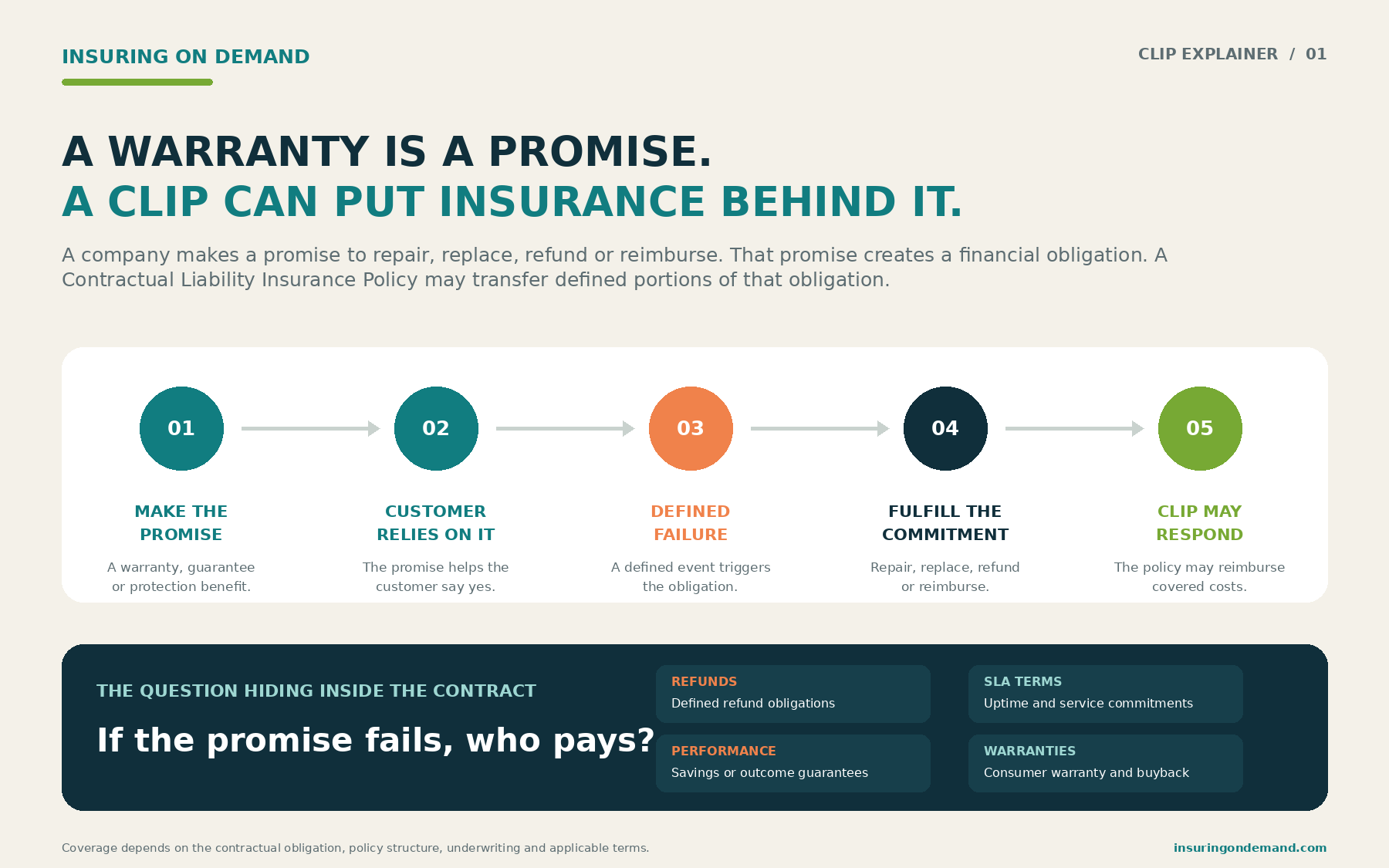
Contractual Liability Insurance Policy flowchart showing how a warranty, refund or performance promise can become an insurable contractual obligation.What does CLIP stand for in insurance?
CLIP stands for Contractual Liability Insurance Policy.
It is a commercial insurance product designed to cover certain contractual obligations accepted by an insured business. In a full-reimbursement structure, the policy may reimburse the business for covered amounts it spends fulfilling a designated contractual commitment.
The important word is defined. A CLIP is not insurance for every promise, dissatisfied customer or contract dispute. The obligation, trigger and benefit have to be understood and structured with the insurance.
How does a Contractual Liability Insurance Policy work?
The basic idea can be explained in five steps:
A business makes a defined promise. The promise may involve a refund, warranty, service level, savings commitment or performance result.
The promise becomes part of the customer agreement. It helps explain what the customer receives if the company does not meet the commitment.
A defined event triggers the obligation. The agreement determines what constitutes a failure and what the company must do.
The company fulfills the commitment. It may issue a refund, credit, repair, replacement, buyback or other stated benefit.
The CLIP may reimburse covered costs. Any payment remains subject to underwriting and the policy’s terms, conditions, limits and exclusions.
The policy and the customer promise must be designed to work together. Insurance cannot repair unclear contract language after the fact.
What contractual obligations can a CLIP potentially support?
The available structure depends on the business and the agreement, but CLIP opportunities can include:
Refund obligations tied to a defined event
Service-level agreement violations, including certain uptime commitments
Performance shortfalls under measurable pricing or service models
Consumer warranties and buyback programs
Portfolio refund risk created by a group of contractual promises
Savings guarantees or other performance-based pricing commitments
Revenue guarantees and outcomes-based enterprise contracts
Termination-for-convenience exposure in certain government contracts
These are different versions of the same underlying question:
What has the company promised to pay or provide if the stated result does not occur?
Examples of businesses that may have a CLIP opportunity
SaaS and API companies
A software company may provide uptime commitments, unused-credit refunds or other remedies if the service does not meet an agreed standard.
Cloud infrastructure providers
Cloud businesses may accept contractual obligations connected to availability, performance or service credits.
Consumer-product companies
A manufacturer or consumer-goods business may offer a warranty, replacement commitment or buyback program.
Businesses offering financial or refund guarantees
A company may promise a refund, credit or defined payment when a particular condition is met.
Companies using performance-based pricing
A service provider may tie part of its compensation to uptime, savings, revenue or another measurable outcome.
Venture-backed companies using guarantees to win business
A growing company may use a meaningful performance promise to remove friction for enterprise customers. That promise can also create a concentrated balance-sheet exposure as sales increase.
Contractors and manufacturers
A contractor may want to provide a meaningful warranty on its work. A manufacturer may want to guarantee that a product will meet defined quality standards. In both cases, the promise can become part of how the business differentiates itself.
Why a CLIP is more than warranty insurance
Warranties are an important CLIP application, but they are not the entire story.
The same structure may be relevant when the obligation involves:
A refund instead of a repair
A service credit instead of a replacement
A savings commitment instead of a product failure
A revenue or performance guarantee instead of a traditional warranty
That is why “insurance for warranties” may be a useful starting search, but the more accurate question is whether a measurable contractual promise creates a financial obligation that can be insured.
CLIP insurance is not ordinary contractual liability coverage
The phrase “contractual liability insurance” can create confusion.
Many insurance professionals use contractual liability when discussing liability assumed under a contract and addressed within a commercial general liability policy. A Contractual Liability Insurance Policy, in this context, is a separate structure built around the insured business’s obligation to fulfill a defined promise.
The words may sound similar, but the coverage problem is different. A company should not assume that an ordinary general liability policy automatically funds refunds, service credits, warranties or performance guarantees.
Why would a company use a CLIP?
A properly structured CLIP may help a company:
Protect its balance sheet from a defined contractual exposure
Offer a stronger warranty or guarantee
Give an enterprise customer greater confidence in a commitment
Support performance-based pricing
Make a refund or buyback program more scalable
Turn a customer promise into a structured, insurable event
Create a differentiated product or embedded benefit
The insurance is not the promise itself. The business still needs a clear customer agreement, a measurable trigger and a process for determining when the obligation has been met.
The question hiding inside the contract
Most businesses begin with a sales question:
Would a stronger promise make customers more likely to buy?
The risk question comes next:
If the promise is triggered across many customers, what will it cost us to fulfill it?
That is where CLIP insurance becomes relevant.
The company may already be carrying a meaningful obligation on its balance sheet. Or it may want to introduce a new guarantee but avoid retaining the entire financial exposure.
What should a business bring to the first CLIP discussion?
A fully developed insurance submission is not necessary to begin. The starting information is usually more practical:
What does the company want to promise?
Where will that promise appear in the contract?
What event triggers the obligation?
What must the company pay or provide?
How many contracts, customers or transactions are expected?
Does any historical fulfillment or loss information exist?
Who will determine whether the promise has been triggered?
How could the obligation grow as the business scales?
Those answers help determine whether the idea is suitable for a CLIP discussion and what additional underwriting information may be needed.
Could your company use a Contractual Liability Insurance Policy?
If your business offers—or wants to offer—a warranty, refund, service-level commitment, buyback, savings guarantee or measurable performance promise, there may be a CLIP opportunity worth evaluating.
Tell us what the company wants to promise. We can help determine whether insurance can be structured behind it.
Frequently asked questions about CLIP insurance
What is a CLIP in insurance?
A CLIP is a Contractual Liability Insurance Policy. It can potentially cover defined contractual obligations accepted by a commercial business.
What does a CLIP cover?
Depending on its structure, a CLIP may support covered refund obligations, SLA violations, performance shortfalls, warranties, buybacks and other measurable contractual commitments.
Can a CLIP cover a warranty?
Potentially. Consumer warranties and buyback programs are among the applications that may be considered, subject to underwriting and policy terms.
Can a CLIP cover a performance guarantee?
Potentially. Performance-based pricing, savings guarantees, revenue guarantees and outcomes-based contracts may create obligations that can be evaluated for CLIP insurance.
Is a CLIP the same as general liability insurance?
No. A CLIP is designed around specified contractual obligations. General liability insurance primarily addresses covered third-party bodily injury, property damage and related liability exposures.
What industries can use a CLIP?
Potential target classes include SaaS and API companies, cloud infrastructure providers, consumer-goods companies, businesses offering refunds or warranties and venture-backed companies using performance guarantees.
Coverage is subject to underwriting and the specific terms, conditions, limitations and exclusions of the policy. A CLIP does not make every contractual obligation insurable.
